
As we approach the end of 2025, it is the perfect time to spotlight the resources that have helped shape housing affordability policy, research and discussions this year in North Carolina. Whether you're a policymaker, researcher, advocate or just someone wanting to know more about housing affordability challenges and opportunities in the state, these tools and reports are essential gifts to the field.
1. NC Housing Snapshot Data Tool – NC Housing Finance Agency
The NC Housing Snapshot is a new, interactive tool that brings housing data to life across all 100 North Carolina counties. Curious about affordability trends, housing supply or demographic changes? This tool can support the work of affordable housing practitioners and advocates with up-to-date data and trends over time.
2. Hurricane Helene's Impact on Housing in Western North Carolina – Federal Reserve Bank of Richmond
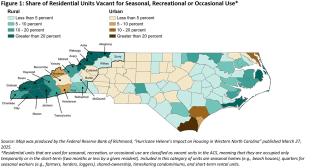
This research published by the Federal Reserve Bank of Richmond explores Hurricane Helene's impact on housing in Western North Carolina. The report found that Western North Carolina was facing a tight and unaffordable housing market even before Hurricane Helene—with rising prices driven by population growth and a limited supply of housing. Helene further exacerbated these challenges by causing significant damage to homes and infrastructure, further reducing housing availability and disproportionately affecting lower-income residents. Figure 1 below shows one of the report’s findings: many counties in Western NC have a high share of residential units used for seasonal or recreational use, reflecting the region’s popularity for tourism and second homes, which limits housing availability for year-round residents.
3. Point-In-Time (PIT) Count and Annual Homelessness Assessment Report (AHAR) – US Department of Housing and Urban Development
Released in December 2024, the 2024 PIT Count revealed that more than 770,000 people were experiencing homelessness in the US, an 18% increase from the previous year [i]. North Carolina saw a similarly sizable increase: 19% more people experienced homelessness in 2024 than in 2023. While overall homelessness rose sharply, veteran homelessness declined—by nearly 8% nationwide and 12% in North Carolina. The report also highlighted the urgent need for affordable housing and continued investment in evidence-based approaches to addressing homelessness.
Check out the data and the report.
4. Housing Supply Gap Analysis, State of North Carolina – NC Chamber Foundation and Bowen Research
The NC Chamber Foundation’s Housing Supply Gap Analysis, conducted by Bowen National Research, identified a shortfall in both rental and for-sale housing in every North Carolina county. The report projected housing supply and demand trends from 2024 to 2029, highlighting gaps driven by population growth, job expansion, housing conditions and affordability trends, and estimated a statewide shortage of 764,000 housing units (322,000 rental units and 442,000 units for sale).
5. The Role of the Low-Income Housing Tax Credit in Preserving Affordability 2025 – NC Housing Finance Agency
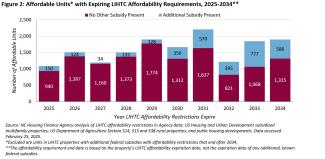
A new white paper published by the Agency explored the critical role of the Low-Income Housing Tax Credit (LIHTC) in preserving affordable rental housing as properties approach the end of their 30-year affordability periods. Specifically, the paper highlighted the risk of losing affordability for more than 16,000 affordable apartments across the state in the next decade without proactive recapitalization and rehabilitation. Figure 2 below shows the number of affordable units with expiring LIHTC affordability requirements for each of the next 10 years.
6. The State of the Nation’s Housing 2025 – Harvard JCHS
The 2025 update of The State of the Nation’s Housing by Harvard’s Joint Center for Housing Studies highlighted a deeply challenging housing market in the US. Record-high home prices, elevated interest rates and increased insurance and property tax expenses have intensified the financial stress on potential homebuyers and homeowners. And despite an increase in multifamily construction, rental affordability has worsened, with a record number of renters facing cost burdens and homelessness increasing sharply. While the report focused primarily on national findings, state- and metro-level data showed that North Carolina is experiencing many of the same challenges.
Read the summary of the report on the JCHS blog.
Check out the full report and statewide data.
7. Home Ownership Affordability Monitor – Federal Reserve Bank of Atlanta
The Federal Reserve Bank of Atlanta created the interactive Home Ownership Affordability Monitor to illustrate how interest rates, pricing, taxes and income shape local housing market affordability. For North Carolina, 31 metro markets (inclusive of 61 counties) are included in the dashboard. It is a powerful tool for understanding how housing costs stack up against local incomes.
8. Summary of the Housing Provisions in H.R. 1 – Bipartisan Policy Center
H.R. 1 (Public Law No. 119-21.), also known as the One Big Beautiful Bill Act, was signed into law in July 2025. The final version of the bill included several provisions that expand financing for affordable housing development and preservation, including permanently increasing 9% LIHTC allocations by 12% and lowering the private activity bond financing threshold from 50% to 25%. The Bipartisan Policy Center created an explainer summarizing the housing provisions and what they could mean for housing supply and affordability in the coming years.
9. Rural North Carolina Continues Population Growth – NC Rural Center
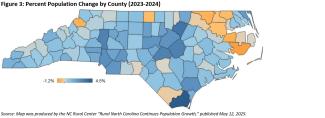
Published by the NC Rural Center, this report highlighted that rural North Carolina experienced population growth from 2023 to 2024, adding more than 38,000 residents. This increase was driven largely by positive net migration (more people moved in than out), which was large enough to mitigate the natural decrease in population in these areas (more people died than were born). While population growth was more widespread than in previous years, it remained uneven: 13 rural counties, largely concentrated in the northeastern part of the state, faced population decline. See Figure 3 below.
10. Policy Matters Blog – NC Housing Finance Agency
Released monthly, the NC Housing Finance Agency’s Policy Matters Blog shares analysis and insights on the latest research, data and policies shaping housing supply, demand and affordability in North Carolina. Stay informed with the latest updates by subscribing here.
Check out previous Policy Matters Blogs.
----------------------
[i] For the purposes of the Point-in-Time Count (PIT Count), individuals experiencing homelessness include people who, on a single night in January, are staying in emergency shelters, transitional housing, safe havens designated to provide temporary living arrangements or staying in places not meant for human habitation, such as streets, vehicles, parks, abandoned buildings, etc. Because the PIT Count only includes data from a single night and excludes certain populations and housing situations, it is widely considered an undercount of the total population experiencing homelessness. See, for example, US Government Accountability Office, 2020. Homelessness: Better HUD Oversight of Data Collection Could Improve Estimates of Homeless Population. Washington, DC. Available here.